

 Suche
Suche
 Mein Konto
Workplace evaluation: Occupational safety in the automotive workshop
It's better to be safe than sorry: The basic idea of the evaluation is that employers take care of the safety and health of their employees - before something happens. The automotive industry shows what is important.

Workplace evaluation: Occupational safety in the automotive workshop
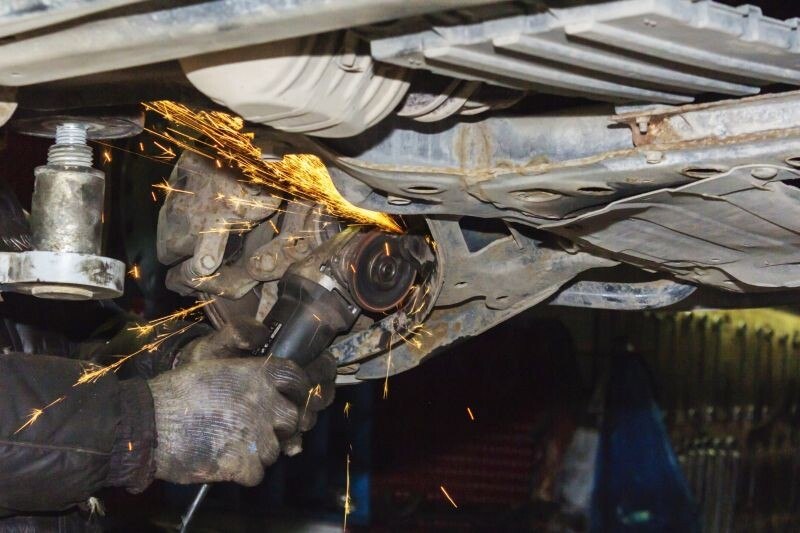
For most people, work is an essential part of their lives. You should treat your health carefully and responsibly in order to maintain your performance in the long term and avoid accidents. Both are in the interests of employees and employers alike. Especially in car workshops. There are many dangers lurking in a workshop and technical developments are not making them any less.
Occupational safety and health protection can only be achieved together in the company, especially in the workshop. In order to achieve optimal workplace quality, those responsible in companies are legally obliged to systematically identify and assess all risks and health risks to which people are exposed at work.
Workplace evaluation: Where are the dangers lurking?
Based on the results, suitable hazard prevention measures are then determined for the company. This entire process is called “job evaluation.” This must then be recorded in the so-called safety and health protection documents and, if necessary, made available to the labor inspector, for example.
Hazards and health risks can have a variety of causes in a workshop, such as machines and tools, chemicals and radiation, noise and vibrations, stress and time pressure, room climate and lighting or posture and handling of loads. There are numerous potential sources of danger, especially in the automotive workshop, especially in connection with the operation of machines. “Many accidents happen with hand machines (drills, flex, grinders, etc.) and hand tools (screwdrivers, cutting tools, tin snips, etc.) because damaged or incorrect tools are used or simple protective measures are ignored,” says the AUVA. This has created a guide for companies on workplace evaluation and occupational safety in vehicle workshops.
Electric cars require special protection
A complete operating manual as a central source of information is of central importance here. Regular maintenance and checking for obvious defects is equally important.
In addition, electronic storage and equipment are potential sources of danger and the increasing use of voltages above 30 V AC (alternating voltage) and 60 V DC (direct voltage) in vehicle technology through alternative drives such as fuel cells, hybrid technology and electric vehicles. This leads to an electrical hazard due to body current and arcing when working on vehicles, which in turn creates special requirements for occupational safety.
The safety and occupational health care required in Austria is carried out in workplaces with up to 50 employees through inspections at least every two years (1-10 employees) or every three years if there are only office workplaces and every year (for 11-50 employees). These inspections can be requested free of charge from AUVA, provided that the employers do not employ more than 250 employees in total.
Occupational Safety and Health Act as a mandate to employers
The legal basis for the evaluation in Austria is the Occupational Safety and Health Act (ASchG) and the associated regulations. The ASchG contains the legal mandate for employers to identify and assess risks associated with work on their own responsibility and, as a result, to determine, document and implement measures to eliminate or reduce them as much as possible. The aim is to continuously improve working conditions, which should lead to the prevention of work accidents and a minimization of work-related sick leave.
The evaluation is intended to enable the employer to continually improve and monitor the safety and health protection of employees in a systematic and organized manner. The employees directly affected must be included in the evaluation concept, as the Austrian Chamber of Commerce emphasizes.
The principles of risk prevention
During the evaluation, the employer must apply the following principles of risk prevention in accordance with Section 7 ASchG:
- Vermeidung von Risiken,
- Abschätzung nicht vermeidbarer Risiken,
- Gefahrenbekämpfung an der Quelle,
- Berücksichtigung des Faktors „Mensch bei der Arbeit“,
- Berücksichtigung der Gestaltung der Arbeitsaufgaben und Art der Tätigkeiten der Arbeitsumgebung, der Arbeitsabläufe und Arbeitsorganisation,
- Berücksichtigung des Standes der Technik,
- Ausschaltung oder Verringerung von Gefahrenmomenten,
- Planung der Gefahrenverhütung,
- Vorrang des kollektiven Gefahrenschutzes vor individuellem Gefahrenschutz,
- Erteilung geeigneter Anweisungen an die Arbeitnehmer.
In principle, the employer can carry out the evaluation himself. If necessary, appropriate specialists such as safety specialists or occupational physicians should be called in. However, the responsibility always lies with the employer.
These 8 criteria must be taken into account
In particular, the following criteria must be taken into account:
- die Gestaltung und die Einrichtung der Arbeitsstätte,
- die Gestaltung und der Einsatz von Arbeitsmitteln,
- die Verwendung von Arbeitsstoffen,
- die Gestaltung der Arbeitsplätze,
- die Gestaltung der Arbeitsverfahren und Arbeitsvorgänge und deren Zusammenwirken,
- die Gestaltung der Arbeitsaufgaben und die Art der Tätigkeiten, der Arbeitsumgebung, der Arbeitsabläufe sowie der Arbeitsorganisation,
- der Stand der Ausbildung und Unterweisung der Arbeitnehmer sowie
- besonders gefährdete oder schutzbedürftige Arbeitnehmer.
Prevention measures are determined based on the identification and assessment of the risks. The results of the risk assessment and the associated risk prevention measures must be recorded in the safety and health protection documents (evaluation documents). The documentation must be kept up to date.
Evaluation is an ongoing process
The identification and assessment of risks must be reviewed if necessary and adapted to changing circumstances. This must be done in particular after accidents, when illnesses occur that are suspected to be work-related, the introduction of new work equipment, working materials or work processes as well as new findings in the area of work design and at the request of the labor inspectorate.
The Chamber of Commerce and AUVA have created sample forms for evaluation and documentation. These forms are on the website https://www.eval.at/ – a joint project of the AUVA, the WKO and the AK with, as it is said, “friendly support from the ÖGB and the Industrial Association” – available.