

 Suche
Suche
 Mein Konto
Industry supports zero”
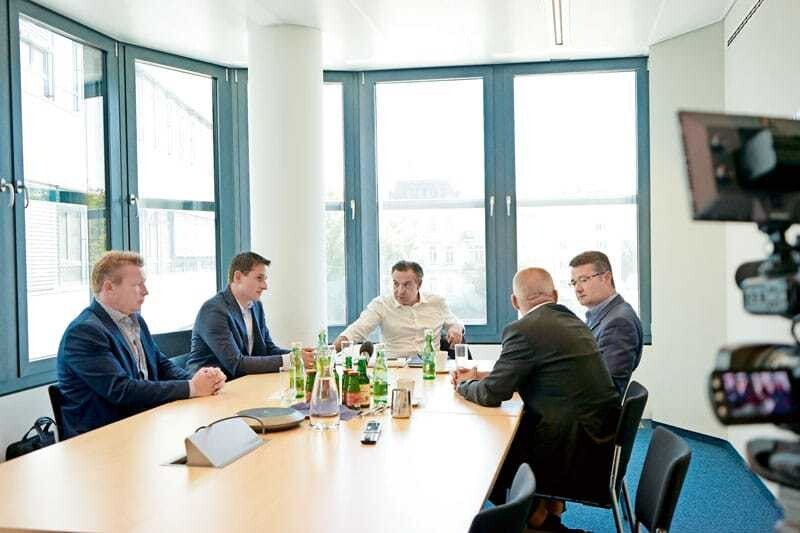
Tire Round Table of the Automotive Industry: With editor-in-chief Wolfgang Bauer, the industry grandees Thomas Bodyt (CEO Apollo Vredestein), Walter Wittmann (tire dealer), Markus Popp (Regional & Sales Manager Euromaster) and James Tennant (VRÖ chairman & tire dealer) discuss the explosive topics surrounding tires.

Industry supports zero”
Automotive industry: Mr. Wittmann, how is the tire business going at the moment?
Walter Wittmann: The tire business is no better than any other. We currently have a lousy economic situation in Austria. The political framework is bad and getting worse. Especially in Vienna, the red-green politics is extremely harmful.
How do you specifically feel this in your companies?
Walter Wittmann: The purchasing power of end consumers is now horribly weak. Today people come with vehicles that they used to drive in Bulgaria. Seven to eight out of ten cars are in a price range of 1,000 to 3,000 euros. In general, cars have lost enormous importance, and that is bad for our entire industry. Thomas Körpert: I see the overall situation as similarly negative. It is becoming increasingly difficult to maintain the quantities. The tire market is basically relatively stable, but no significant increases are expected. We are still lucky in that we are not very dependent on the economy, but rather depend on whether people are driving or not. The overall mileage decreases slightly, but not really dramatically. We have to learn how to run a business sensibly with the volume we have. Admittedly, the industry earns a lot of money, but no longer in Europe because the markets here are saturated.
Mr. Tennant, how are you doing in your company?
James Tennant: I agree with Mr. Wittmann insofar as the general conditions in Austria are becoming increasingly difficult. Especially when it comes to bureaucracy and laws. On the one hand, I think the world belongs to the hardworking. On the other hand, I don't believe that companies can grow endlessly. I also feel my customers' declining purchasing power, you can just tell that people are saving. While a certain brand and quality awareness has emerged in recent years, today people are turning more to cheap strips again. In my company we are very focused on premium products, but we cater to all customer wishes. More and more customers are coming with tires from the Internet.
Do you send the customers away or install the tires?
James Tennant: I can't afford to send anyone away. The big opportunity for tire retailers is and remains to explain to the customer what this supposedly low-interest product can do. I see this opportunity when someone comes from the Internet with tires. I can advise him so that he comes straight to my specialist store next time. Business was going well until the end of May. June was weak, but we're used to that.
Markus Popp: Our end consumer business declined in the spring. However, we score very strongly in the car service sector, where we have managed to grow for years. The leasing fleet business is a very important factor for us. We score points with our service and the reputation we have built up. Many studies and mystery shopping shows that the tire trade has a catastrophic image. I also carry out such tests myself again and again. The customer's needs analysis is not really determined. There is still enormous potential in personal support and advice. Our most severe competition is the car dealership, and they are constantly gaining market share. We have to differentiate ourselves.
Walter Wittmann: I strongly disagree that the tire trade generally provides poor advice. This may apply to individual exceptions.
Mr. Tennant, what do you, as VRÖ chairman, say about the bad image of the tire retailer?
James Tennant: Sometimes the quality of sales conversations leaves a lot to be desired. During the season, however, it is very difficult to give sound advice due to the cumulative rush of customers.
Do you also notice more price sensitivity among end consumers?
Markus Popp: Definitely yes. We completely ignore cheap products. The general conditions are not getting any better. But we can inspire those who buy tires with our premium products.
Thomas Bodyt: We are having a harder time with the Apollo brand because we are in the dead center, so to speak. There are many competitors here who are also well-known. We are consistently successful with our premium brand Vredestein. Sales are growing and we are gaining market share.
Walter Wittmann: In principle, I remain rather pessimistic. Mr. Tennant, if someone comes to my company with 400 euros, simply doesn't have any more and needs four tires, then you can have the best salesman, but the customer still won't buy four tires for 600 euros.
Mr. Körpert, you work in many companies. What impression do you have of the external appearance?
Thomas Bodyt: I think that a lot of positive things have happened and that there is not a lot of catching up to do. However, if you stop trying to get better, you will no longer be good. It's about constant optimization. To put it bluntly, the dealer's problem is that he earns less and less and has to invest more and more. It's not worth investing more and more to secure your margins when margins are falling.
Walter Wittmann: Our problem is also that we are much worse than the car dealership when it comes to advertising and marketing.
Is the industry providing enough support?
Walter Wittmann: I don't notice anything from the industry. So not even anything.
Has it gotten worse?
Walter Wittmann: Yes, in any case. There are no ideas whatsoever. At most, a poster stand will be brought over once that I don't need. The industry could, for example, initiate an event together with us. That all stopped.
When was the turning point and since when has there been no more support?
Walter Wittmann: About ten years ago.
Why is that?
Walter Wittmann: This is due to the changed market share ratios. About 15 years ago, Michelin and Semperit almost shared the market.
Thomas Bodyt: Mr. Wittmann is right, it used to be easier because the return was much higher. The industry also made a higher margin, which could then be invested. Industry today also has the same dilemma that retail has. Admittedly, the industry is in a better position because it is largely global.
Markus Popp: The German market is usually two to three years ahead of us. The current tire study by the BRV (the German counterpart to the VRÖ; editor's note) shows that the tire trade will not survive like this sooner or later. Partnerships are the magic word. However, I have often had the experience that many dealers simply refuse any support or further training. When retailers say when it comes to partnerships: I expect the best price and I'll do everything else myself anyway, then that's not enough.
Does the tire trade have a future?
Markus Popp: Absolutely. Family-run businesses with long-term regular customers and optimal customer loyalty will be particularly successful. But they also have to contend with lower margins and rising costs. And they too will have to think in new directions.
Walter Wittmann: When was the last time you, Mr. Popp, were in my company?
Markus Popp: That was a long time ago. Four or five years ago.
Walter Wittmann: Why not for so long?
Markus Popp: I have to take myself seriously. I missed that.
Walter Wittmann: And you, Mr. Tennant?
James Tennant: I've never been to your company.
Walter Wittmann: Why not?
James Tennant: You have a telephone. We at VRÖ can be reached at any time. The VRÖ offers so much for retailers. Of course we can visit any dealer, but you can also contact us. We can work together on topics that will help the association, but also the industry. But the problem is: Nobody in the industry wants to help each other.
Topic of sales channels: The tire retailer complains about the Internet and the car dealership. Where does the tire roll?
James Tennant: How do we get the internet under control? In fact, not at all. Whether the network is good or bad is irrelevant, it exists and we have to come to terms with that.
Markus Popp: The car dealership is increasingly relying on tires to drive traffic. The car dealership is already at 23% sell-out. Thank God the tire trade still has 40%. That means: We have to look for ways to inspire people as tire professionals. On the other hand, you have to say that with the car service we offer competition to the car dealership.
Mr. Wittmann, what can you do better than the car dealership?
Walter Wittmann: Nothing.
Then why should I come to you?
Walter Wittmann: Because I am local to the region. The car dealership has a huge advantage in its sales structure. Today I don't see a single customer from the VW Group anymore. I don't even have the chance to advise this customer. The VW train has left for the tire trade. Most vehicles we see start at four or five years old. When the second set is needed.
Thomas Bodyt: You have to look at it from the customer's perspective. Why does he go to a specialist dealer and why to a car dealership? There is practically no selection at the car dealership, and there is practically only the winter tire shop. Nobody buys summer tires in a car dealership. Customers go to the car dealership because they make their convenience purchases there and have everything from a single source. The customer probably thinks that the authorized dealer knows my car and also knows which tires are good for it.
Willhaben conducted a survey for us via Marketagent in which almost 3,000 end consumers were asked: “Do you pay attention to the brand when buying tires?” 28.5% say: yes, definitely; 43.8% say: yes, more likely. Is this pleasant or socially desirable behavior?
Thomas Körpert: For me, brand is a synonym for premium. It's a no na result. Because if you ask someone today: What car would you like to have? Then everyone says Mercedes, BMW or Audi. Basically, I think customers don't want something cheap, they just don't want to spend money. I maintain that every Hyundai driver would actually rather have a BMW.
Markus Popp: Customers definitely value the brand. But the price-performance ratio must be right.