

 Suche
Suche
 Mein Konto
ÖAMTC winter tire test 2021
This year's ÖAMTC winter tire test reveals once again: There are hardly any really bad tires anymore. Unless you go for no-names from the Far East.

ÖAMTC winter tire test 2021
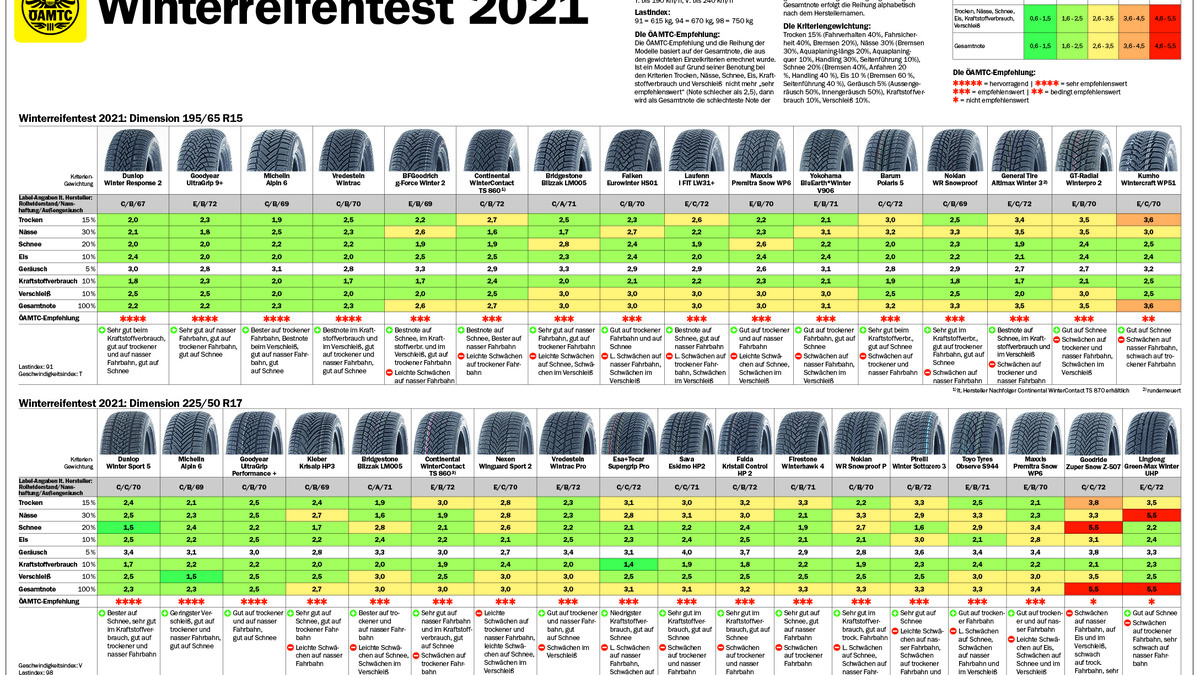
In the 2021 winter tire test, the ÖAMTC and its partners tested 34 models in the mid-range dimensions 195/65 R15 91T and 225/50 R17 94V in terms of their driving and safety properties. Comfort and economy were also examined. ÖAMTC technician Steffan Kerbl summarizes the results: "Seven winter tires were rated as 'highly recommended'. With each of these models you get a balanced tire without any major weak points." The majority of the products tested this year (24) were rated “recommended”, one was “conditionally recommended” – and the ÖAMTC cannot make a recommendation for two tires. “Finding a winter tire that offers safety and driving comfort while also helping to save fuel shouldn’t be a big problem in 2021,” says Kerbl.
Test 15-incher
In one of the best-selling winter tire dimensions (195/65 R15 91T), four models are “highly recommended”: Dunlop Winter Response 2, Goodyear UltraGrip 9+, Michelin Alpin 6 and Vredestein Wintrac. Kerbl explains: "Ultimately, these products only differ in details. An example: Dunlop and Vredestein are characterized by particularly low fuel consumption, but in return they have to give way to Goodyear when it comes to performance on wet roads." These differences should not be ignored, but ultimately with each of these winter tires you get a very balanced product in all categories.
The midfield is made up of eleven models in this tire size that were rated “recommended”. “The weak points of the individual tires are not too big, but they differ depending on the model,” says the ÖAMTC technician. “The performance on wet roads is usually not entirely satisfactory; some tires also have minor problems in the dry and on snow or are not entirely convincing in terms of fuel consumption.” The weakest 195 in the current ÖAMTC winter tire test is the Kumho Wintercraft WP51, which was the only one rated “conditionally recommended”. "A close result - if the tire had been a bit better on dry roads, it would have been enough for a 'recommended' rating, despite slight weaknesses in the wet. Annoying for Kumho, because in all other criteria the Wintercraft WP51 can easily keep up with the midfield."
Test 17-incher
Essentially, the larger dimensions reveal a similar picture to that of the 195s: the models from Dunlop (Winter Sport 5), Michelin (Alpin 6) and Goodyear (UltraGrip Performance +) can also be recommended to every consumer here. Goodyear offers the most balanced product, Michelin has designed the model with the least wear and Dunlop has designed the best for snow roads. Behind the top 3 there is a broad middle field with products from a wide variety of manufacturers. If you are looking for a winter tire that has a particularly positive effect on fuel consumption, you can choose the ESA+TECAR Supergrip Pro, which achieves the best values in this criterion.
“But there are not only positive things to report about the 225s,” says the ÖAMTC expert. “The mobility club clearly advises against purchasing the Goodride Z-507 Super Snow and the Linglong Green-Max Winter UHP.” With the Goodride, the explanation for the poor result lies in the properties on snow, especially when starting and handling. The Linglong, on the other hand, could even be found in the front midfield in snow, but it falls through on wet roads. "There is nothing to sugarcoat here - after all, snow and wetness are road conditions that occur very frequently in winter. It is therefore clear that the mobility club cannot recommend either of these two models," Kerbl concludes.