

 Suche
Suche
 Mein Konto
Does trade have a future?
Tire round table of the automotive industry: Does the tire trade have a future? Is the Internet a threat? Does the tire have to remain a low interest product?

Does trade have a future?
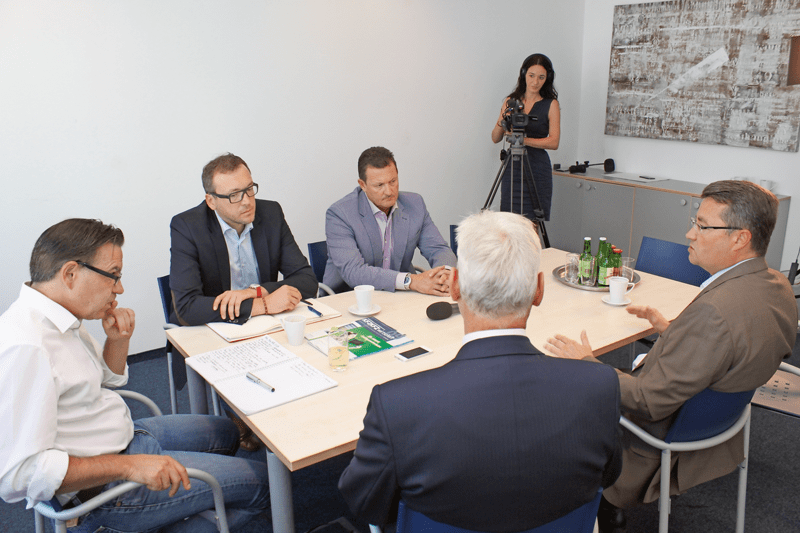
Automotive economy:Mr. Schramm, you recently said in an interview with me: “Of course we need tire retailers.” Why do you believe that?
Claus-Christian Schramm: The tire retailer has a very clear traditional position and logistical obligation, which it fulfills as part of guaranteeing mobility for end consumers. We at Goodyear Dunlop support independent specialist retailers as best we can. In addition, more and more end consumers are storing their tires at specialist retailers. Capacity is always almost exhausted.
Thomas Body:The tire trade has a future because there is no alternative. There are numerous tire segments that would be unthinkable without specialist retailers. From agricultural tires to forklift tires. Also in the car sector: without the specialist retail base, the car dealership could only do half as well. The more complex the topic of tires becomes - and it will be in the future - the more specialists are needed.
Does the industry take adequate care of its dealers or is there always a tendency towards car dealerships anyway?
Claus-Christian Schramm: I don't think the trend is towards car dealerships. It is difficult to answer whether we are doing enough because we can always do more. But the question also arises as to whether what we do will be accepted.
Will the TPMS opportunity be accepted by specialist retailers?
Thomas Bodyt: The specialist dealers have recognized the tire pressure monitoring systems as an opportunity and are doing it very professionally. Now is the time when the topic really becomes topical. Personally, I have no doubt that the specialist dealer would not be TPMS compatible.
Mr. Peschek, you recently emphasized that the industry is concentrating more and more on car dealerships. Specialist retailers should focus on a premium brand as well as Nokian, Hankook, Vredestein and Falken.
Michael Peschek: There are brands that support specialist retailers in their pricing. And there are those that can be found in a wide variety of sales channels and put retailers at a disadvantage in terms of price. The reason for this: concepts from the large German market are often simply imposed on our market. Keyword: waterfall concepts. For a hybrid retailer that operates wholesale but also has a service station, the conditions are – to put it politely – suboptimal. I praise the brands you mentioned before because they give retailers fair prices and give us the opportunity to show off our skills. Today's premium brands generally do not give us this option.
Mr Schramm, Goodyear Dunlop was not mentioned.
Claus-Christian Schramm: We are the ones who have to support this waterfall concept, especially since we have neither an Austrian nor a German price concept, but a European one. A broad brand portfolio that is, so to speak, lumped together across Europe means that these concepts are difficult for specialist retailers to understand. Nevertheless, we try to be fair. But price is always a critical issue.
Hermann Hladky:More and more people are advocating for entering into partnerships and forging collaborations. Not just in terms of fair prices, but also in terms of training on how products can be sold optimally. Quantities and volumes have been taken away from the tire trade and shifted to the car dealership, so I would think that makes sense.
Mr. Körpert, to what extent will the sales structure change, where will the tire roll?
Thomas Körpert: The Internet has become an integral part of business. Here it is important to differentiate between B2B and B2C. Both are trending upwards. In my opinion, convenience plays a big role in B2C. This means that end consumers can make an appointment with the retailer via the Internet outside of normal opening hours. The problem is: Internet makes everything very transparent, which means that everyone tries to be the cheapest. This is not good for earnings. So the question is: How can prices be generated via tyre24, for example, that still give everyone enough room to breathe?
There will always be providers who try to succeed based on price. You can't order this from above...
Hermann Hladky: If there is no way to set such prices, then they won't exist. Due to overproduction, we experience prices that are no longer understandable.
Michael Peschek: In the B2C sector, everyone tries to be the cheapest. Of course, only one person can be the cheapest. An example from Germany: The tire discounter has set incredibly aggressive prices in order to secure market share. Basically it was successful and captured six percent of the market share in two seasons. However, these were taken exclusively from the Internet segment because the overall market share of the Internet has not grown. I therefore don't think it makes sense to go online through aggressive pricing. Here's what I'm seeing on our own website: We have 700 clicks and one purchase. I conclude that the Internet is primarily used to obtain information in advance. In general, internet buyers are cheap product buyers.
Claus Christian Schramm:On the subject of the Internet: In the future, our tires will be available everywhere at any time. For specialist retailers this means: they must have at least an online shop.
Will the tire actually remain a product that requires intensive advice?
Michael Peschek: That is exactly the challenge we are facing. We have been seen as craftsmen for the last 50 years. We now have to manage to transform from a craftsman to a service provider within a very short space of time.
It's about selling this service appropriately and being proud of it. Is this awareness too low?
Hermann Hladky: This awareness is partly due to ignorance, e.g. B. in terms of cost costs etc. As far as TPMS is concerned: Both the industry and the VRÖ have done a lot and helped here. Every company that calculates sensibly knows how much extra time it needs for TPMS and also that it has to offset these costs. Companies in my field of experience – and the results of mystery shopping also show this – are absolutely TPMS-fit.
Michael Peschek: A BRV study shows that calibrating a vehicle takes eight minutes. That's true if I say in advance e.g. For example, you already know that on a Lexus the calibration button can be found on the lower side of the brake pedal. If I don't know this, it might take me two hours to find the button. One of our market competitors, who has an industry behind them, offers this service for 1.50 euros. We can't work eight minutes for 1.50. TPMS will become truly relevant for the first time next winter. Unfortunately, there are market competitors who - before the first customer arrives - ruin the price so that it is below cost price. That's frustrating.
Thomas Body:The specialist retailer will never be the cheapest. He has to find something where he can win. There's a whole lot. Whether service, service, quality, advice or convenience.
Does the tire industry explain its products adequately? Is enough desirability created?
Thomas Körpert: I think we don't explain it enough. I was last at the IAA. If you don't know this, you can't imagine the desire that is created there. Admittedly, an automobile evokes more emotion. But: At Audi, nobody tries to be the cheapest. We can learn from the premium car manufacturers: This costs money, but you have such and such advantages. We in the industry can create desire and emotion, but this also has to be implemented by specialist retailers. For example, by retailers forging alliances with manufacturers. Retail has this option.
Claus Christian Schramm:The end user has, so to speak, abandoned the tire medium. He hands over his key and has no connection whatsoever. There is therefore no connection to the retail service. We at the manufacturer present the tire emotionally. However, that is not enough to appeal to the general public. We only reach motorsport enthusiasts. Basically, the point is that the end consumer should find a world of experience in which everything fits.
What screws could you turn in terms of desire and emotion, Mr. Peschek?
Michael Peschek: Explain what differences there are in the product that looks more or less the same. For example with the topic of security. Or rolling resistance, i.e. saving fuel.
Hermann Hladky: The issue of security is undoubtedly the easiest because it is a basic need of every human being. To ensure that the tire does not remain a low-interest product, more awareness must be created. At the moment the only question is: Where can I get the product cheapest? Or tires are given as a gift with the new car. As a tire trade, we would have to do it the other way around. We would have to join forces, e.g. B. buy some Golfs and sell them off. I would like to see what happens then. That's the crux of the matter. If it doesn't cost anything, it's worth nothing. The fact that tire manufacturers are bringing a full-season tire onto the market is crazy for retailers. I can't possibly recommend something like that.
If the customer requests it.
Hermann Hladky:The customer only demands what is available.
Michael Peschek:We can tell the customer: The all-season tire may be suitable for Hamburg, but it is not suitable in our Alpine region with snowfall in winter.
Claus Christian Schramm:This is certainly not the optimal product for frequent travelers in Austria. But there are also areas of application that are definitely growing in which all-season tires are a good alternative. In metropolitan areas, for example, where only a few kilometers are driven. From a dealer's perspective, it's clear that you have to stick with customers changing summer and winter tires.
Hermann Hladky:Another sentence on the topic
Desirability:When I go into a car dealership today, the atmosphere is completely different.
The tire retailer obviously failed to invest in the external appearance while they were still making money.
If the tire trade is lagging behind the car trade experience, what can be done now, or is it already too late for everything?
Hermann Hladky: It's not too late. As I said, there is the possibility of cooperation or alliances, where things can then go towards a world of experiences.
Mr. Peschek, how does the tire trade have an advantage over the car dealership?
Michael Peschek: First and foremost, we are the experts. We are not quota sellers, unlike car dealerships that have pressure from the parent company. We can respond to the customer and offer them a tailor-made package, completely independently.