

 Suche
Suche
 Mein Konto
The cyber tire from Pirelli
The Italian tire manufacturer Pirelli has brought a tire connected to the car into series production with the Cyber Tire System. That's what's inside - and behind it.

The cyber tire from Pirelli
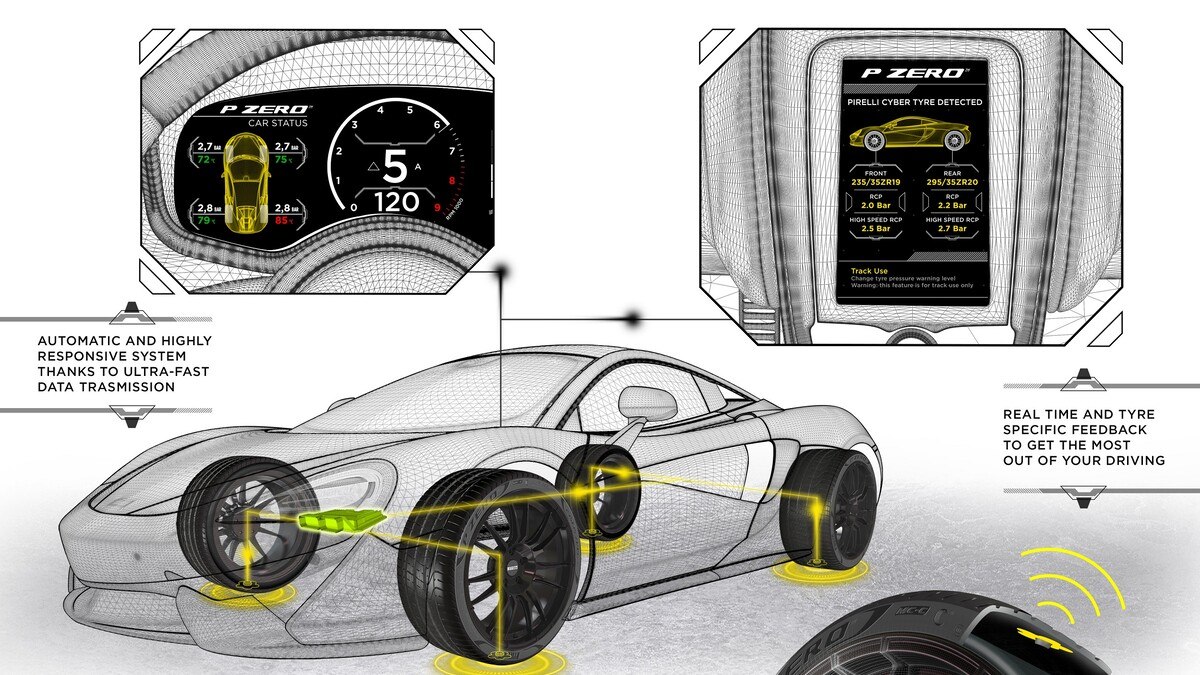
For the first time, Pirelli is equipping a tire with sensors as standard that can communicate with a car. This world premiere in original equipment is based on thePirelli Cyber Tire System. There is a sensor in each tire that records important data while driving and sends it to the car's on-board computer. The first production model with this technology is the McLaren Arthur.
Cyber Tire technology provides the car and driver with a wealth of information, including:Type of tire, whether it is a winter or summer version, to the prescribedPressure, for theLoad indexand toSpeed class. Add to thatcurrent operating information such as temperature and air pressureof the tire.
Direct contact
The information – including tire pressure and temperature data that is constantly monitored and transmitted in real time – is crucial for safety. Compared to conventional sensors on the valve (TPMS), the system provides more precise information because the transmitting sensors from Pirelli are in direct contact with the tires instead of with the rims. The data provided by the sensors is processed by software developed by Pirelli, which is integrated into the vehicle's electronics. Some of this information can be seen on the dashboard and central display; other information is used by the vehicle electronics to match the driver assistance systems based on the exact characteristics of the tires and their status.
Warning if necessary
For example, a car equipped with the Cyber Tire System can alert drivers that tire pressure needs to be checked. Or if the tire type was changed during the conversion season - for example from summer tires to winter tires, which often have a different speed rating - the car warns the driver as soon as the maximum speed for that tire type has been reached. The specific functionality of the cyber tires is selected and defined by the automobile manufacturers, depending on the respective vehicle model for which the cyber tires are used.
Pure performance
In the case of the McLaren, some of these features were specifically chosen for use on a race track. For example, the Pirelli Cyber Tire allows drivers to adjust tire pressure to suit their individual driving style for better performance on the track. As a result, the information that the respective driver receives changes. You can also be notified when the tires have reached the optimal temperature, so you can take advantage of the tires' optimal temperature window to get the maximum performance from the car tire package. In addition, it can be communicated when the tires need to cool down again.
Wide range of applications
The Pirelli Cyber Tire System is intended to represent the future of tires: it is capable of giving the car a sense of touch, allowing it to detect potentially dangerous situations such as loss of grip and aquaplaning, allowing the car's electronics to intervene immediately. The next step will be tires that are connected to other vehicles and the surrounding infrastructure. Back in November 2019, Pirelli was the first tire manufacturer in the world to share information about the road surface via the 5G network. This was made possible by intelligent tires that are equipped with sensors. They were introduced during the “world’s first 5G-enhanced ADAS (Advanced Driver Assistance Systems) service” presentation in Turin.
The systems are constantly evolving, just as the systems for autonomous driving are becoming more and more advanced. The tasks that drivers still carry out today - assessing the grip level of the road and the weather conditions - are increasingly being handed over to the tires. This means the car will automatically slow down if conditions become slippery, with driver assistance systems activating to increase safety. Because vehicles are interconnected, a car will be able to inform other driverless cars of an impending danger. All of this adds up to a real sense of touch for the only part of the vehicle that has contact with the road: the tires.