

 Suche
Suche
 Mein Konto
Suzuki SV 650 test - retro or standstill?
My first motorcycle was a Suzuki SV 650 S, built in 2004, the angular one. A great motorcycle. Now, 13 years later, it is back, the SV 650, after the Gladius tried to take its place. Not much has changed on the motorcycle. Is that bad or good? Let's just try it.

Suzuki SV 650 test - retro or standstill?


ergonomics
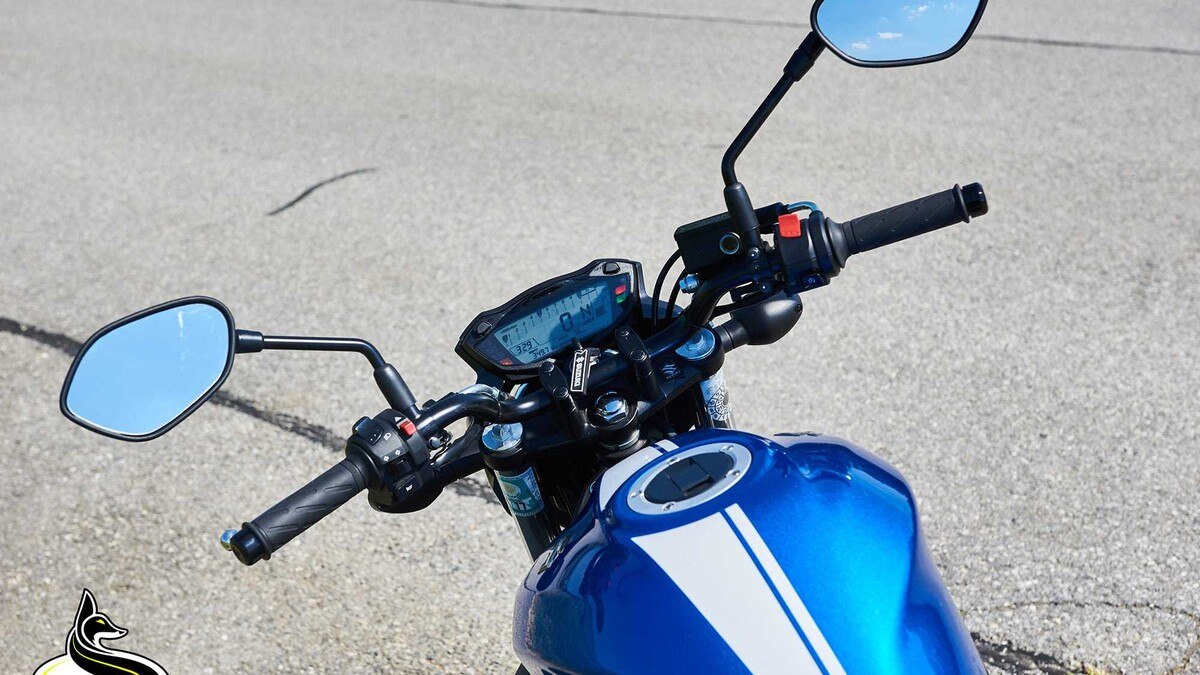
The Suzuki SV 650 is extremely slim. Not even the original SV with a carburetor was that slim. The seat height of 785 mm is comfortable, and the narrow tank means you have a secure footing even with shorter legs. Grip the handlebars, which are cranked up quite a bit and are rather narrow in the hand. The knee angle is relaxed but active, the knee position is very narrow due to the 13.8 liter tank and you have the feeling of moving a delicate, compact motorcycle. The brake lever is adjustable, but unfortunately the clutch lever is not. The covering of the fully digital speedometer even offers some wind protection. From 150 km/h it still becomes tiring on the neck. A small windshield is not a bad idea for long-distance drivers.
Handling
With a full tank of exactly 200 kilograms, the Suzuki SV 650 is not the lightest in its segment. But you can't see or feel the extra few kilos on her. Hardly in motion, the SV is pleasantly agile and presents itself with good balance and equilibrium. After just a few corners, their driving behavior changed to the throttle hand and the driver's butt. Never bitchy, more on the handy but not nervous side, you swing from one curve to the next. Up to top speed there are no nasty pendulum movements or straight-line stability problems. Nevertheless, I would give the SV a wider and slightly deeper handlebar. That looks better and would make it even more light-footed and possibly also slightly increase the feedback from the front. Although the front wheel offers enough feedback, in slow corners it is a little more difficult to feel exactly whether the grip limit is already dangerously close. The rear is completely different, as it clearly shows the driver how the rear rubber harmonizes with the floor covering.
Engine/gearbox
There it is again, the SV 650 engine: 645 cubic meters, 64 Newton meters, 76 hp. 90-degree two-cylinder, liquid-cooled. Beginner heart, what more do you want? First gear, clutch click and the SV is on the rear wheel and wheels and wheels and wheels. There is no traction control - nor is it needed. The engine is still a model boy. One that brings joy to both novice and experienced Herbrenners. With minimal vibrations, silky-smooth, direct throttle response and mild load change reactions, the engine pushes with a pleasant thud from the bottom without lacking in revving. It only starts to stop at around 9000 revolutions. Until then, the engine pulls wonderfully linearly with a slight kick at the top. That's how it works. Unfortunately, the transmission on the test motorcycle couldn't quite keep up. I kept making mistakes, the routes were a little longer than usual and every now and then there were a few problems. Unusual for a Suzuki gearbox. It could possibly be because the test SV was still virgin with around 500 kilometers on the clock and the transmission still needs to be broken in. Nevertheless, with all forbearance, there was just too much trouble, that could be done better. The clutch could be operated precisely and with little manual effort. A plus point when riding the rear wheel or in tight bends.
Undercarriage
As is typical for this class, we are talking about simple, barely adjustable spring elements. A non-adjustable telescopic fork is used at the front. Unfortunately, nothing has changed here compared to the previous models. Too bad. The SV 650 S at least had a preload adjustment. After all, the preload of the monoshock, which is articulated via levers, can be adjusted 7 times - just like before. There are no more settings. Also typical for its class, the chassis of the SV 650 is on the soft side, but not quite as smooth as some of its competitors. When saddled up, she doesn't bend her knees mercilessly, but only sags minimally. Feels good. When driving, you can feel a dip when braking, but even with my ready-to-drive weight of almost 90 kilograms, you can't feel any slumping without the damper. The rear works surprisingly precisely and even on faster laps the rear doesn't start pumping uncomfortably. Of course, the chassis offers a lot of potential for improvement, but the latest generation chassis feels a bit firmer and more balanced. The 160 mm rear tire remained. Good for handling, but the looks are debatable.
Brakes
There's not much new when it comes to the brakes either: there are two 290 mm brake discs with two double-piston floating calipers on the front wheel. The axial brake pump has an adjustable brake lever and offers mediocre feedback. On the one hand, the brake doesn't really bite in a sporty manner, but rather very gently, and on the other hand, the lever travel is also a little longer. The ABS shines on the other hand - similar to that Suzuki V-Strom 650 – pulsates very gently on the lever and doesn’t start too early. The rear wheel brake is easy to control. And because the weight distribution is slightly more rear-heavy, the deceleration for the rear wheel is really good.
Noticed
Round headlights with small lamp fairings, the rear wheel swing arm is now slightly more rounded, the tank is smaller and narrower, the rear has been completely restyled. Otherwise there are hardly any new features with the SV 650. The sound is rather subdued, but the seating position is comfortable and absolutely suitable for long journeys. Personally, I really like the new speedometer.
Failed
The front brake is a bit too lax and the tank is not exactly generous at 13.8 liters. The retro trend is already fading away, so the SV 650 appears unusually old-fashioned with its round headlight and few visual highlights. And please: the cruel tiled tank panel (fake carbon look) really causes eye cancer. Who came up with this nonsense?
Test result SV 650, by p.bednar
More information about Suzuki SV 650
With kind support from TOTAL Austria
More action photos from the test drives can be found on Instagram: apex_moto_at
Or follow us on Facebook: Apex Moto