

 Suche
Suche
 Mein Konto
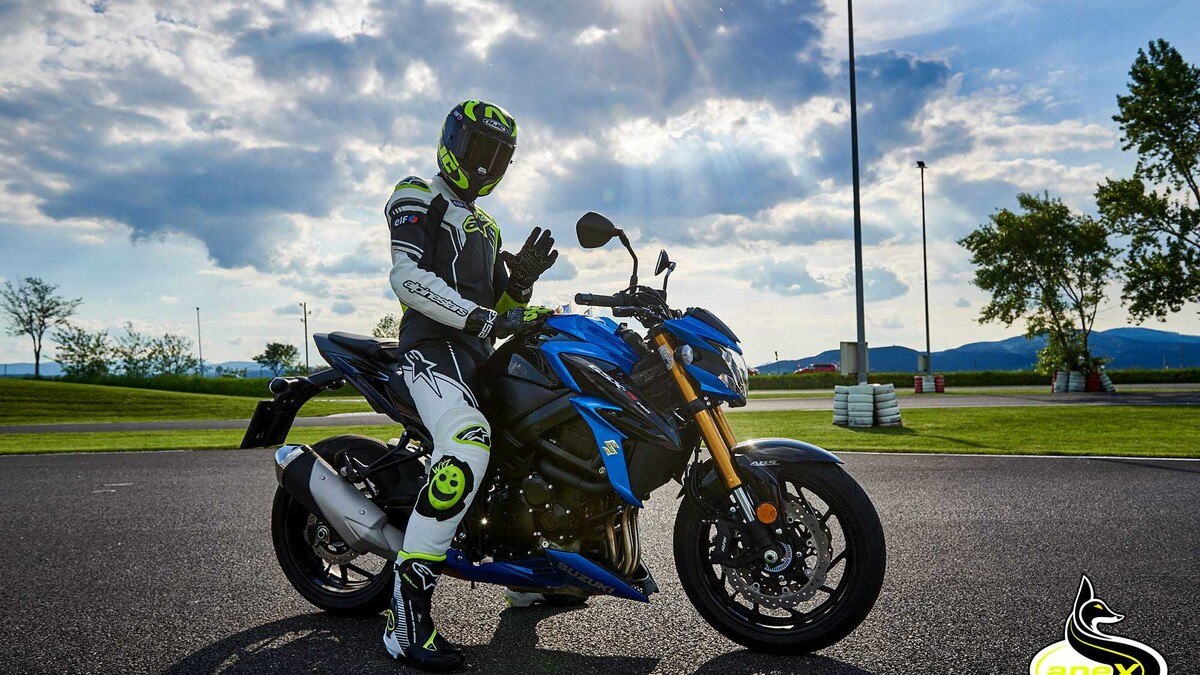
Suzuki GSX-S750 test - the naked truth
When I had a Suzuki GSX-R 750 as a long-term test motorcycle for almost a season, I often wished that the Japanese would transplant exactly this engine into a stylish naked bike and not skimp on the chassis. The Suzuki GSR 750 was a first attempt in this direction, but I personally never liked the motorcycle enough. The new GSX-S750 is visually extremely successful and is much closer to a naked GSX-R 750. The driving pleasure was great, but there is still a small downer.

Suzuki GSX-S750 test - the naked truth


ergonomics
Saddle up, grab the steering and lo and behold, you have the feeling of having the front axle in your hand. I've only seen this front wheel oriented from a few Ducati Monster vintages. The narrow, short headlight reinforces the impression even more. Nevertheless, you don't have any uncomfortable weight on your wrists, as the seat height (820 mm) and knee angle are very consistent. The saddle is comfortable and well shaped. If you make yourself small on the GSX-S750, you have enough space to push your butt back and then get some support from the pillion cushion. The knee joint is - typical of in-line four-cylinders - not super tight, but narrow enough to be able to maneuver the motorcycle using the thighs. Despite my height of 1.85 meters, I sit comfortably on the GSX-S750 and can also go on longer tours with it. Fits, sits, doesn't pinch. Continue in the text.
Engine/gearbox
When you first pluck the accelerator, the in-line four of the GSX-S750 is sympathetically tame. The engine needs speed to get lively - of course. If you give him this, it will be fun. The hoarse hissing and rattling from the airbox (GSX-R feeling arises) literally drives the pilot to speed orgies. From 5000 rpm the engine pushes powerfully. From 7000 onwards things really start to move forward. Vibrations? Nope, nothing. The four-in-line engine is silky smooth, and you only feel certain load change reactions when you abruptly turn on the accelerator. In order to race quickly through the curves, you have to keep the speed at least above 5000 rpm. Things get rather dull underneath when you first turn on the gas. The engine doesn't jerk even when idling. The engine should deliver a maximum of 114 hp – a credible value. You can feel the 81 Newton meters especially in the raised center, where you can cruise around without changing gears - despite the R4. The Suzuki transmission is impeccable: the gears are easy and precise to engage, and the distances are just as short as you need them.
Undercarriage
Here the GSX-S750 shows two faces: On the one hand, the fork and shock absorber can only be adjusted in terms of spring preload, the fork is infinitely variable and the shock absorber can be adjusted seven times. But that's not enough for me. On the other hand, the spring elements worked very well at cooler temperatures up to around 20 degrees, above which the fork in particular became significantly too soft in the compression stage. Hard braking and the fork dives deep. Finger away from the brake and the fork quickly returns. The diving is further intensified by the very front-wheel-oriented seating position. Heavier pilots (from approx. 80 kilograms) will probably not be able to avoid adjusting the fork if their driving style is ambitious. The chassis offers a lot of comfort and also filters out nasty asphalt edges well. You pay the price for this on perfect, flat roads, where the last bit of feedback is missing due to the generally softer basic setup. But I found the feedback from the rear precise enough to switch off the traction control completely.
Brakes
Similar to the chassis, the braking system is also a bit of a compromise. The rear brake can be finely adjusted, but was otherwise rather inconspicuous. The front brake looks great: 310 mm wave brake discs and radial brake calipers. You soon noticed the differences to the super sports stoppers: the pads always bite into the discs in a discreetly sporty way, but they don't decelerate quite as crisply as their disguised sister. This is wonderful for everyday use - and that's where the GSX-S750 is used 99 percent of the time - because you don't have to be afraid of bold braking even in the wet. But if you want to reduce your lap times, you will need steel flex brake lines on the one hand and more snappy pads on the other. Incidentally, the ABS intervened rarely and then quite sensitively for the class. If the fork had been tuned a little tighter in terms of compression, there would probably be a little more braking performance. But all in all, the brake can definitely be used for sporty home track laps.
Noticed
The high-quality workmanship and the – finally – tastefully thought-out finish. The black Fatbar handlebars look elegant and valuable, as do the matching black levers and footrests. It wasn't always the case that Nipponbikes were in perfect harmony. The display is wonderful, the “menu navigation” – there isn’t that much anyway, apart from traction control and trips – simple and obvious. Personally, I like the look a lot and is a significant improvement over the rather well-behaved, not quite as harmonious predecessor, the GSR 750. The weight, ready to drive and with a full tank, was 204.1 kilograms. Well below the factory specification (213 kg).
Failed
Rubber brake hoses! Still. Why, Suzuki, why? And I completely misunderstood: the spring preload on the fork, which as we know only adjusts the vehicle level and the negative spring travel, still has S and H on it. I guess for soft and hard. But if you change the spring preload, the fork doesn't get harder or softer because the spring stiffness doesn't change. I find it stupid. And as attractive as the display is, the speed bar at the top edge is really difficult to read, especially if you press more sportily and can't look between the radii at the cockpit forever.
GSX-S750 test result, by p.bednar
More information about Suzuki GSX-S750
With kind support from TOTAL Austria
More action photos from the test drives can be found on Instagram: apex_moto_at
Or follow us on Facebook: Apex Moto