

 Suche
Suche
 Mein Konto
Test Kawasaki Z900 – Godzilla’s little nephew
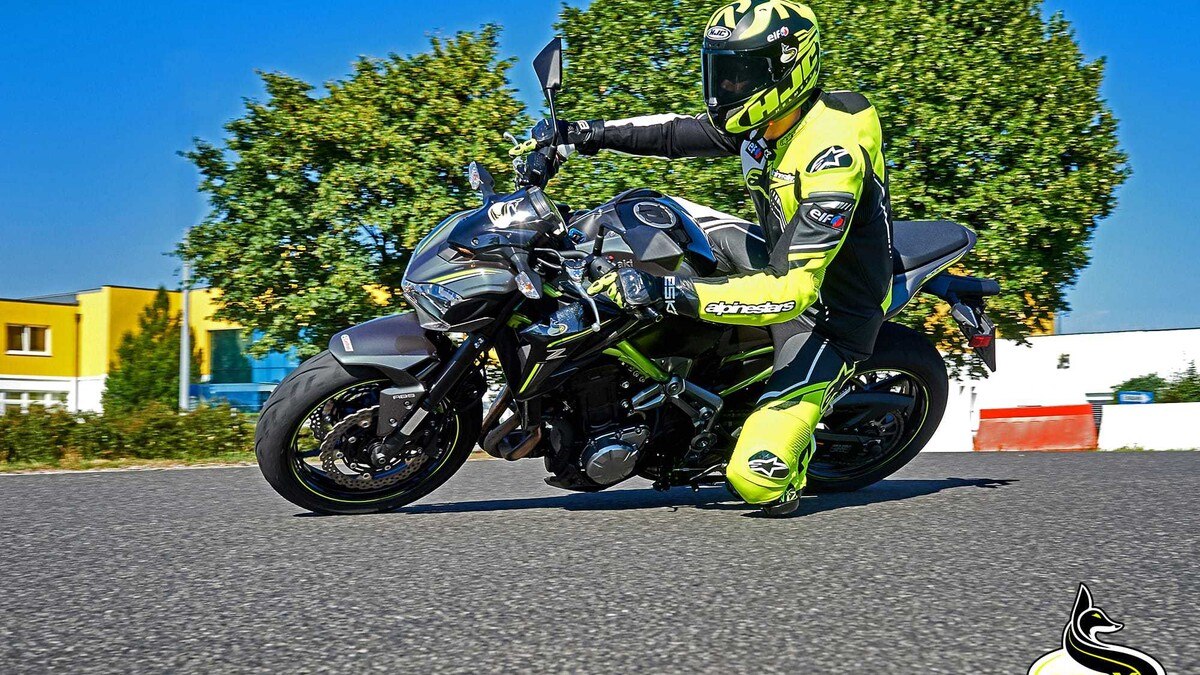
Crisp, clear edges, minimalist splashes of color, an evil look and a tight rear - the Kawasaki Z900 is a fierce naked bike. Almost mangy – in a good way. After just a few minutes in the saddle of the Z900, it becomes clear: It's not Godzilla, but at least his little, aggressive nephew who wants to eat you with all your skin and hair.

Test Kawasaki Z900 – Godzilla’s little nephew


ergonomics
Welcome to the saddle of an honest naked bike: The knee angle is pleasantly sporty, the seat is centrally located in the middle of the motorcycle (seat height 795 mm) and the wide handlebars only stretch the pilot over the front wheel in a discreetly sporty way. The wild ride begins in a comfortable but still active way. At just under 209 kilograms, ready to ride and with a full tank, the Kawasaki Z900 was just under the factory specification (210 kg). The Akrapovic exhaust, which is subject to a surcharge (from 861.50 euros), probably made the difference.
Handling
Due to the pleasantly neutral seating position, I expected the same handling. And get it too. Naked bikes tend to be more on the agile side; here and there there is slight handlebar fluttering or swinging around the longitudinal axis at top speed. Not so with the Z900. Here the Japanese engineers have found exactly the right balance between agility and stability. Even in brutally fast corners, the Z900 stays firmly on the road and draws exactly the line through the corners that was specified when you first turned. Similar to the Kawasaki Z650, the big sister shines with a great, confidence-inspiring balance: not nervous, not wobbly, but not cumbersome or stubborn either. This is exactly how a naked bike should be controlled. Pleasant: Line corrections are still possible even when the angle is very tilted. This gives you a lot of security and trust - even if you have targeted a corner a little too optimistically.
Engine/gearbox
Applause, applause! According to Kawasaki, the in-line four-cylinder with 948 cubic meters produces 125 hp. Subjectively, they are extremely lively horses that compete courageously in the lower and middle speed ranges and then pick up the pace again at the top. However, the torque is much more exciting than the performance: 98.6 Newton meters are stated. And it feels like they're already there from idle. Rather atypical for a four-cylinder, the Kawa engine has so much boom in the middle that you think you're sitting on a big V2. There aren't many in-line four-cylinder engines that make me rave, but the Z900 engine really packs a punch. The Z900 excels, especially on country roads, where top-end power is much less important than a powerful middle. It's easy to go a gear higher into the corner without starving at the exit of the curve. The gearbox cooperates and the gear changes are so smooth. When it comes to drive, the Z900 has earned a “very good” rating.
Undercarriage
Kawasaki takes an interesting approach with the fork: the 41 mm USD fork is adjustable for spring preload and rebound, but only on the left bar - for both. To be honest: I didn't even notice it when I was testing it, and I didn't even know it. The shock absorber is also adjustable in spring preload and rebound. Interesting: On our test motorcycle, the preload was completely out except for one thread. That also somewhat explains why the lean angle wasn't all that great. The footrests made contact with the ground quite early. Heavier riders could do some readjustment here to adjust the rear level and the negative spring travel. But the last one worked well. According to information from Kawasaki Austria, the low spring preload is the factory setting. Overall, the chassis is very everyday-oriented - not too tight and not too lax. I especially liked the fork. Although there is nodding in when braking here too, it is significantly less - in direct comparison to the Yamaha MT-09 or the Suzuki GSX-S 750. This is particularly pleasant at the entrance to a curve, as there is less movement in the fork and it feels firmer. Nevertheless, the first centimeters are comparatively soft, before a very transparent progression occurs and the fork becomes significantly tighter. Overlooked asphalt edges do not arrive unfiltered in the handlebars, but are largely noticeably ironed out. A very fine tuning for country roads and the driver's normal weight. The rear seemed a little too soft to me. The Z900 sagged a bit when sitting on it and there was some movement when moving between changes of direction. Never bad, never annoying, but still noticeable. Here too, progression soon sets in and dampens the first vibrations. Overall, the chassis layout fits very well with the Z900's primary area of application, namely country roads. Precisely because the chassis is not as hard as a board, it absorbs exactly those bumps that require a little more attention from the pilot with firmer chassis, very calmly and in a way that saves your nerves.
Brakes
Only 300 mm wave brake discs are used at the front. At first glance they seem more sweet than brutal. But in conjunction with the axial brake pump and the - unfortunately only - axially screwed brake calipers, the Kawasaki Z900 bites hard and doesn't decelerate brutally but courageously. Personally, I would have liked a little more feedback on the brake lever, but that's complaining at a high level. The rear wheel brake is pleasingly effective and can be finely adjusted. I didn't notice much about the ABS. If it did happen, it was probably from the rear brake. The minimal pumping of the handbrake lever during use comes quite late. Conclusion: rock solid.
Noticed
How playful the handling of the Kawasaki Z900 is. A few quick corners are enough and you get the feeling that the bike is doing exactly what you want it to do. The sound was a bit subdued – despite Akrapovic. The Euro4 emissions standard is once again to blame here. Great: no traction control. The objective journalist in me wants to criticize it, after all there are other bikes in this price range that have a TC, but since the engine hangs so beautifully on the throttle and has such a strong, transparent center, it doesn't need traction control to be safe and fast. In addition, for me it fits the requirements of a Z naked bike: less is more. The fully digital speedometer with its black display not only looks good but is also very easy to read.
Failed
The rubber brake hoses, again. It really doesn't have to be that way. And axially screwed brake calipers on the front, well, aren't a highlight either. Otherwise I can't think of anything else.
Test result Kawa Z900, by p.bednar
More information about Kawasaki Z900
With kind support from TOTAL Austria
More action photos from the test drives can be found on Instagram: apex_moto_at
Or follow us on Facebook: Apex Moto