

 Suche
Suche
 Mein Konto
The CO2 balance of electric cars
The EU is pushing the switch to electric cars. But is their CO2 balance so much better than that of combustion engines?

The CO2 balance of electric cars
The triumph of electromobility can no longer be stopped. In the past few weeks and months, several large car manufacturers have specified their change of course. Above all, the powerful VW Group, which wants to have converted half of its entire model range to electric cars by 2030 and is aiming for a completely balanced CO2 balance across the group by 2050. Rival Renault is even more ambitious: the French want to offer nine out of ten new cars with purely electric drives by the end of the decade. The transformation ambition is being fueled by politics: The EU Commission has just presented the long-awaited climate package “Fit for 55”. Their proposals are intended to be a roadmap to the goal of saving at least 55 percent of greenhouse gases by 2030 compared to 1990. Part of it focuses on the automotive industry: new cars should no longer emit CO2 emissions from 2035. But how environmentally friendly are electric cars and therefore all of e-mobility really?
Carbon footprint: It's about more than just operations
Are electric vehicles actually more environmentally friendly than modern combustion engines, be they petrol or diesel? Experts also argue about this. Ultimately, not only the (non-existent) emissions during the drive must be considered, but also the pollutants produced for the entire lifespan of the car. "Electric cars drive locally emission-free. That doesn't mean that they also drive CO2-free, because the generation of electricity has to be taken into account," explains Prof. Martin Doppelbauer from the Karlsruhe Institute of Technology (KIT), where he holds a professorship for hybrid electric vehicles, in a guest article in the magazine "Auto Motor Sport".
The question of environmental friendliness, the actual CO2 footprint of electric vehicles, can only be answered with the help of a comprehensive environmental balance. The entire life cycle of vehicles is taken into account: from the production of all components including the battery, to the operation of the vehicle and the energy required for it, as well as the maintenance effort and right up to the disposal of the car. The German Federal Ministry for the Environment, Nature Conservation and Nuclear Safety (BMU) has drawn up such a holistic assessment. The result is the study “How environmentally friendly are electric cars?”
Why so many studies are misleading
It also explains why there are so many different, sometimes misleading or contradictory reports about the environmental friendliness of e-cars: According to the BMU, the most common reasons for this include the comparison of different vehicle characteristics (e.g. classes, engines and battery sizes), the consideration of different balance sheet sections (e.g. just vehicle production) and various assumptions about the electricity mix in e-car production and use. In addition, outdated data is sometimes used, especially for batteries. Speaking of batteries: The assumptions about the lifespan of a battery for electric cars are often very different in various studies. In short, apples are often compared with oranges and incorrect or at least outdated data is sometimes used.
CO2 electric car: The electricity mix is crucial
The electricity mix primarily determines whether an electric vehicle performs better in terms of its carbon footprint than a combustion engine. While such a vehicle runs without emissions, power plants certainly emit greenhouse gases when providing charging current, at least if fossil fuels are used.
In countries like Germany and Austria, more and more renewable energies are being used to generate electricity. In 2019, for example, their share in Germany was around 41 percent, and in Austria in the same year it was as high as 75.1 percent, according to Statistics Austria's energy balance. This compares to an EU average of 34.1 percent. In any case, the trend is continuing to rise; in Germany, more than half of the electricity will soon come from renewable sources for the first time. However, with the current German electricity mix, electric cars are significantly more climate-friendly than combustion vehicles.
This is confirmed by Prof. Doppelbauer from KIT: As he explains, a new car (all drive types) in the EU emitted an average of around 140 grams of CO2 per kilometer in 2020. The increasing number of PHEVs and electric vehicles would have already reduced this value significantly compared to 2019. Electric cars obviously use electricity when driving. According to the expert, a typical value including charging losses would be 22 kWh/100 km. The Federal Environment Agency (UBA) knows how much CO2 has been emitted to date when producing one kWh. This states a value of 366g CO2/kWh for 2020 on its website.
Doppelbauer now calculates: "The CO2 emissions that arise when driving an electric car are then a short distance from a rule of three: 22kWh/100 km x 366 g (CO2)/kWh = 8,052 g (CO2)/100km. This corresponds to 80.5 g/km. Savings compared to the average new car (and as I said, there is already a considerable number in this mix E-cars and plug-in hybrids included): a good 42 percent.”
Batteries have a negative impact on the ecological balance
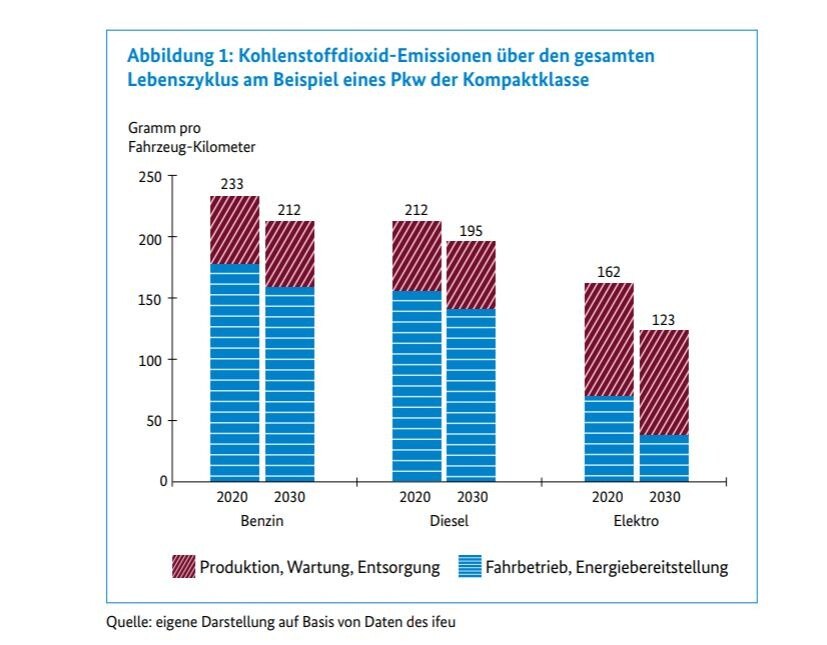
But what about the energy-intensive production of batteries and how does this affect the overall balance? This is, so much in advance, the real mood killer when it comes to e-mobility! Because of the complex and energy-intensive production of the batteries, the entire production, maintenance and disposal of the vehicles account for more in the climate balance than the entire driving operation. And also significantly more than comparable vehicles with combustion engines (see graphic).
Nevertheless, according to the BMU study for electric cars, the balance is still positive overall because the operation is so much more environmentally friendly. "The greenhouse gas emissions of today's compact class electric vehicle are lower over its entire lifespan than comparable vehicles with combustion engines. Compared to a gasoline engine, it produces around 30 percent fewer greenhouse gases. Compared to a comparable diesel engine, it is around 23 percent less," says the study by the BMU, which calculated these values based on data from the Ifeu (Heidelberg Institute for Energy and Environmental Research).
Jürgen Stockmar's verdict is far more critical. The experienced automotive development expert has worked in management at Magna, Steyr Daimler Puch, Opel and Audi, among others, during his career. Today he advises companies in the automotive sector and taught at the TU Vienna. Of course, Stockmar uses an Audi e-tron and therefore a luxury SUV in his calculations. According to Stockmar, the production of a lithium-ion battery would produce 165 kg of CO2 per kWh of battery capacity, according to Johanneum Research. The production of a 95 kWh battery in the Audi e-tron required 15,675 kg of CO2. A vehicle with a combustion engine with the legally permitted CO2 emissions of 95 g per kilometer would therefore run 165,000 kilometers. And even then, the electric vehicle wouldn't be worth it because it still uses electricity during operation.
Divided into an assumed mileage of 150,000, the e-tron in Stockmar's calculation example comes to 104.5 g of CO2 per kilometer through battery production alone. With a vehicle consumption of 15 kWh per 100 kilometers, the current German electricity mix adds an additional 50g of CO2 per kilometer, according to Stockmar. In summer, this results in a total emission (for battery production and ongoing operation) of around 150 g CO2/km. “This CO2 emissions are well above the legal emission limit of 95 g CO2/km,” said Stockmar at an online event organized by MPKA (Motor Presse Klub Austria) at the beginning of 2022. Addendum: “This vehicle does not meet today’s registration regulations!” It is incomprehensible why the emissions caused by battery production are simply ignored by legislators in the EU. Not to mention the energy required to recycle the batteries, which he also left out of his calculations. In fact, the life cycle assessment over the entire life cycle of a vehicle would have to be taken into account.
Renewable energies on the rise
Of course, one thing plays into the hands of e-mobility: as mentioned, the share of renewable energies in the German electricity mix will continue to rise - to at least 65 percent by 2030 in accordance with the federal government's goal. In addition, improvements in battery production can be expected, both in terms of material efficiency and energy use. “If renewable electricity is used for production, the carbon dioxide backpack of the battery is reduced by around half,” says the BMU paper. Although the underlying calculations took into account that petrol and diesel engines are also becoming more economical, a comparable development to that of electric cars is unlikely.
In addition to an increasing share of renewable energies, the study was based on the following assumptions: Production in Europe is assumed for vehicle production, while battery production is taken into account for the current situation according to the current mix of manufacturing countries. The outlook for 2030 then assumed European battery production. This seems reasonable, as there is currently a massive increase in... Expansion of battery production in Europe is invested. VW alone has ambitious plans here.
The addition of biofuels to diesel and gasoline in accordance with national targets and European regulations was also included in the calculations. For electricity and fuel consumption, realistic data from typical example vehicles from the ADAC EcoTest is used, which is significantly higher than the official manufacturer's information. Fleet averages were not taken into account. And in order to enable, as it is called, “a fair comparison between different types of use”, the total emissions were calculated based on an average lifetime mileage of 150,000 kilometers.
Electric car: 40 percent less CO2 consumption
Under all of these assumptions, the advantage of an electric car in 2030 over a gasoline engine in the BMU model calculation will increase to 42 percent and over a diesel to 37 percent. And this despite the energy-intensive production.
Speaking of energy-intensive: Much-discussed alternatives, especially the e-fuels pushed by the industry, have a disadvantage: “The production of these fuels requires more energy than is subsequently available as fuel,” is the conclusion of the BMU experts. At the same time, its use in vehicles with combustion engines is far less efficient compared to electric motors. KIT Professor Doppelbauer agrees: “If you honestly calculate the current fuel consumption of 7.3 liters per 100 km, then synthetic fuels require over 10 times more electrical energy than electric cars.”
Raw material costs are greater for electric cars
A further analysis by the BMU confirms a suspicion that arises from the comparatively high level of emissions in vehicle production: in terms of cumulative raw material expenditure, electric vehicles today perform even worse than combustion engine vehicles. "More raw materials are simply required to produce vehicle components. A number of manufacturing-intensive materials are used, particularly for battery production." This in turn also affects the ecological balance.
Here too, battery production is the biggest spoilsport: lithium-ion technology, for example, requires relevant amounts of cobalt, which is also criticized for its socially and ethically problematic funding conditions as well as its high environmental impact. There is an increased focus here Supply chains and company due diligence obligations a promising approach to combating grievances, according to the BMU, which also promotes the development of recycling processes for new components. And that expresses the following hope: “The further development of production, material efficiency and storage technology will most likely significantly improve the balance sheet.”
Nevertheless, the two main statements of the German study can be summarized as follows: In terms of total raw material consumption, vehicles with combustion engines currently still have an advantage. But in terms of the total energy requirement and thus the CO2 emissions over the entire life cycle - and this is what this article is about - electric vehicles are already clearly ahead due to their high efficiency.
Many other studies now also give electric cars a better rating compared to combustion vehicles, which is mainly due to the high efficiency of the engine. A balance sheet from the ADAC shows that the CO2 disadvantage of battery cars is compensated for when driving between 50,000 and 100,000 kilometers.
Is there even enough (green) electricity?
But will there actually be enough electricity and, above all, enough green electricity if the ambitious electrification plans of the EU and the major European car manufacturers are implemented? “If almost all cars in Germany were electric, we would need between 20 to 25 percent more electricity,” says Doppelbauer. Of course, we are still at least 10 years away from a widespread end to the sale of combustion cars. And then it typically takes another 15 years until the car fleet has largely been transformed. "We are optimistic that we will not be able to fully generate the additional electricity production in 25 years at the earliest. In other words: we only need to build up almost 1 percent additional electricity production per year in order to absorb the additional demand from electric cars."
According to the expert, the real challenges of electromobility lie elsewhere: creating convenient charging options for many millions of people who do not have their own home or parking space. And also in creating competitive cars that are not just converted combustion engines. And finally to ramp up the development and production of the new technologies, optimize them and reduce costs.
The German “car pope”, Prof. Ferdinand Dudenhöffer, emphasized when he was on a flying visit to Austria in early summer 2022 that one could argue in all directions when it comes to the CO2 balance of electric cars: “You can prepare the results the way you want using various assumptions, for example about the future electricity mix.” sends an appeal: “We shouldn’t destroy e-mobility with horrible assumptions!”
Dudenhöffer himself proves to be a fan of electromobility and says: "The future is electric. We shouldn't ruin e-mobility with horrible assumptions!" He estimates that by 2030 two thirds of all new cars sold in Germany will be electric cars. Of course, the demand for electricity will explode as a result, which is why, according to Dudenhöffer, there is hardly any way around nuclear energy. “We shouldn’t close our minds to the discussion about nuclear power,” he said in conversation with the automotive industry, Germany's exit from nuclear power is naive. Well, the EU has already given nuclear power a green label anyway. But this can of course also be debated.