

 Suche
Suche
 Mein Konto
What is a car actually made of?
A car consists of around 10,000 individual parts made from a wide variety of materials. Metal alloys made of iron and aluminum are mainly used.

What is a car actually made of?
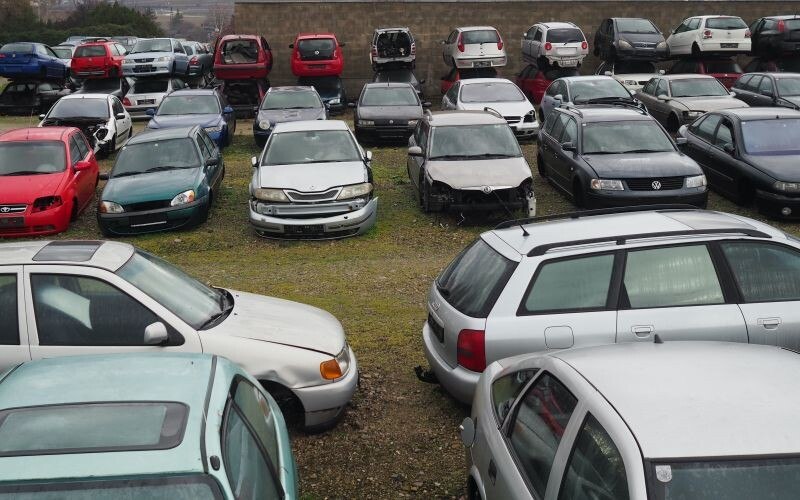
A car with a curb weight of one ton consists of approximately 600 kg of steel, 10 kg of cast iron and 90 kg of aluminum. Pure iron is very soft and therefore unsuitable for vehicle construction. By removing carbon, it is hardened and then processed into steels with different strengths. Steel is the most important material in automobile construction, as it has a wide variety of technical properties that are specifically tailored for applications in the body, chassis, etc. Steel also has very good processing properties, a good price/performance ratio and good recycling options.
Lightweight construction concepts are in demand
In order to achieve the goals set for consumption and CO2 emissions, combustion engines are being optimized and cars must become lighter. 100 kilograms less vehicle weight reduces fuel consumption by approx. 0.6 liters/100 km. These efforts to reduce weight are countered by increasing demands for safety and comfort and an increasing number of electronic components that require holistic measures to reduce vehicle weight. Lightweight construction concepts are becoming widespread in automobile manufacturing. And they lead to conventionally used materials being replaced by new materials.
An essential basis for reducing component weight and thus fuel consumption are steels with higher strength, which, compared to conventional qualities, have a reduction in sheet thickness while maintaining the same structural strength and improved crash behavior. The proportion of such welded blanks or “tailored blanks” in current vehicles is around 50%. “Tailored blanks” are made from thin sheets of different strength properties and material thicknesses, depending on the operational stress, to form components of the body of an automobile. This results in material and weight savings of up to 20%.
Aluminum, magnesium and high-tech steels
In addition to the promising aluminum, magnesium was rediscovered in automobile construction. This metal (with a density of 1.74 kg/dm3) is a third lighter than aluminum and 77 percent lighter than steel. It has already been used in many vehicles for the production of engine and transmission cases. Complex, delicate components can also be cast with magnesium. The new magnesium sheet qualities and forming technologies now also make it possible to use magnesium thin sheets in vehicle construction. Magnesium is the lightest metallic construction material.
The Upper Austrian steel group and automotive supplier voestalpine is responding to the industry's demand for increasingly lighter, but also stronger and more corrosion-resistant components by creating its own field of expertise called "ultralights". This offers a comprehensive range of steels for lightweight automotive construction, from Advanced High Strength Steels (ahss) for cold forming to innovative solutions for hot forming using galvanized press-hardening steels (phs).
Ten percent plastic
In addition to replacing steel with light metals, plastic also plays an important role. Plastics have an average density of 1 g/cm3. Many hundreds of car components are made from it. Today the proportion of the car's dry matter is 8 to 10%, to which the five tires must be added at 3%. The same applies to considerations regarding the stability of plastics against mechanical and chemical stress as to metals. Although they are not subject to corrosion, they are threatened by UV radiation and the resulting oxidation processes. This is why sophisticated additive chemistry is necessary.
Through fiber reinforcement of components, high levels of stability can be achieved, which makes it possible to build car bodies made of plastic. Here, composite materials are used in which glass fibers or carbon fibers (carbon fibers) are embedded in high-quality plastics such as polyester, epoxies and polyamides such as Kevlar. Problems sometimes arise when recycling old vehicles.
The tire of the future
In terms of sheer mass, the tires are hardly significant. However, they are crucial because they are the only contact between the vehicle and the road. A modern tire is not just made of simple rubber; rather, it is a complex mixture of various natural and synthetic rubbers as well as numerous other chemicals and construction materials. Fillers such as carbon black, silica, carbon and chalk are added to the tire compound, while steel, rayon and nylon provide strength. The development here is also exciting: The Tires of tomorrow can do so much more than we can imagine today, there are hardly any limits to the tire industry's fantasies.
In any case, all the efforts to reduce weight in modern automobile construction are countered by increasing demands in terms of safety and comfort as well as an increasing number of electronic components in vehicles. Modern cars have long been rolling computers, which means that the electronics also add a lot to the scale. The electrical system of a modern mid-range car (without a hybrid drive) easily weighs 50 kg and includes hundreds of cables with a total length that can be measured in kilometers.
1.6 kilometers of cable
The Wolfsburg car dealership compares in one Blog the Golf 1 with the Golf 7 and comes to the following conclusion: "In 1980, a total of 191 cables with a total length of 214 meters were installed in a VW Golf 1. In the VW Golf 7 there are almost 1,000 different cables. However, these days we tend to measure in kilometers: the length of the cable network on an averagely equipped Golf is almost 1.6 kilometers." That alone increases the weight. To counteract this, the cross section of the signal lines was reduced from 0.35 to 0.13 square millimeters. There was also a new type of copper-tin alloy.
It's no wonder that on-board electrical systems are becoming more complex: the various comfort components, from the sound system to the air conditioning, are joined by more and more safety-relevant components such as ESP, ultrasonic or video sensors and the control devices required for them. This makes modern ones all the more important for repairs and maintenance Diagnostic equipment, which read out error messages. The increasing number of electronic components also means that over 100 consumers now receive their electricity from the correspondingly required battery.
Fluids and parts loss
And then there are various fluids when the vehicle is ready to drive, which in total can amount to 60 kilograms, depending on the vehicle category. The largest part is the contents of the fuel tank. Smaller cars have a tank volume of around 40 liters, larger vehicles have around 80 liters. In comparison, the three to four liters of engine oil that a traditional car with a combustion engine requires is irrelevant. The same applies to five to ten liters of coolant, as well as one or two liters brake fluid or windshield antifreeze.
In general, the number of individual parts that a car consists of depends on the respective vehicle type. In the upper class, due to the higher level of equipment, there are usually significantly more than in compact class vehicles. According to experts, a mid-range vehicle can be expected to have an average of 10,000 individual parts installed. For electric cars, the number of parts is drastically reduced. A combustion drive alone consists of more than 2,000 parts, while an electric drive only consists of around 250. The liquids mentioned are also largely eliminated, but the batteries weigh between 300 and 750 kilograms, depending on the specific model. But be careful: Electromobility also creates new sources of danger in the workshop Occupational safety and workplace evaluation must be taken into account.