

 Suche
Suche
 Mein Konto
Schaeffler switches semi-automatically
Compared to manual transmissions, Schaeffler's partially automated clutch systems provide greater driving comfort and lower fuel consumption. Compared to fully automatic machines, they are significantly cheaper.

Schaeffler switches semi-automatically
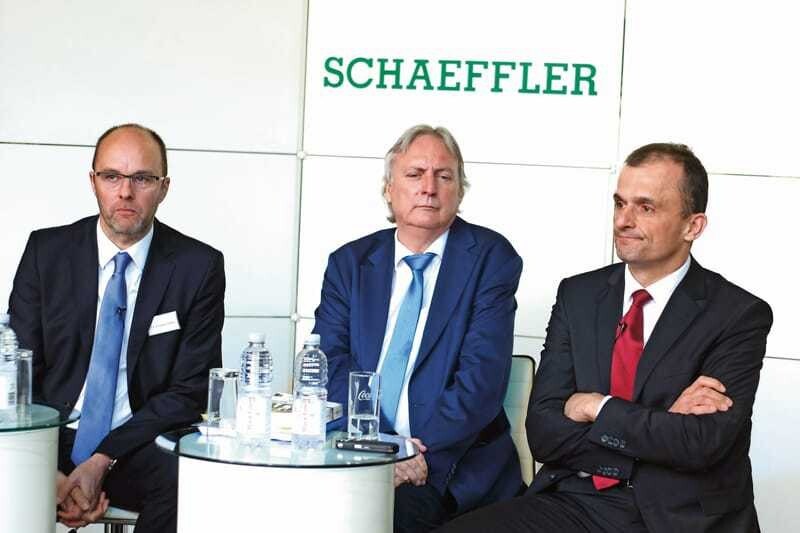
Shifting gears by hand without using the clutch is unusual at first. On a test drive in a Ford Focus with an innovative semi-automatic transmission on board, I learned to keep my left foot still and to shift gears by hand as needed. Also unusual: If I take my foot off the accelerator, the engine simply switches off and the car “sails” along. I wake up the engine again with a short burst of gas; the process is hardly noticeable thanks to a powerful belt starter generator. EKM or “Clutch by Wire” is the name of the system presented by automotive supplier Schaeffler in Baden-Baden, Germany, which simultaneously ensures increased comfort and lower CO2 emissions and is also significantly cheaper to produce than a fully automatic system. The technology behind it: A sensor records the manual switching process and sends the signal to a control unit. This activates an electric motor, which ultimately carries out the clutch process via a spindle drive and master and slave cylinders.
One idea, three concepts
Schaeffler has developed three concepts for different requirements. In the simplest version, MTplus, there is, as usual, a clutch pedal and a hydraulic power transmission, but this is supplemented by an electric actuator in the pressure line. I was also able to test this variant in Baden Baden. Conclusion: There is no noticeable difference to the conventional manual switch with clutch. If I take my foot off the accelerator, the car sails towards the next traffic light with the engine switched off without disengaging the clutch. According to Schaeffler, fuel consumption in the future consumption measurement cycle according to WLTP can be reduced by at least three percent, and the savings in real city traffic should even be up to eight percent. “With MTplus, Schaeffler has managed to keep the additional costs compared to classic clutch actuation within narrow limits,” says Roland Welter, head of the overall clutch system product line at Schaeffler. The third system developed by Schaeffler is called “Clutch-by-wire”. Although there is a pedal, there is no longer any mechanical or hydraulic connection to the clutch. An intelligent electric actuator opens and closes the clutch in all driving situations. This means that the system can also cope with situations that require highly dynamic intervention - for example rapid gear changes and sudden braking.
Mild hybridization
“The interest of vehicle manufacturers in our solutions is great; the first series vehicles will come onto the market in 2019,” promises Matthias Zink, head of the transmission systems division at Schaeffler. Around half of the approximately 80 million vehicles produced worldwide are still equipped with manual transmissions. “There is enormous potential for CO2 reduction here,” says Zink. Likewise in the mild hybrid with a 48-volt system on board, which enables purely electric driving in low speed ranges. “For drivers, this means that they can significantly save fuel at moderate additional costs and at the same time experience more driving pleasure,” says Peter Gutzmer, Chief Technology Officer at Schaeffler AG.