

 Suche
Suche
 Mein Konto
Suffering is everywhere”
The KFZ Wirtschaft paid a visit to CarGarantie in Freiburg in Breisgau and asked CEO Axel Berger for an interview.

Suffering is everywhere”
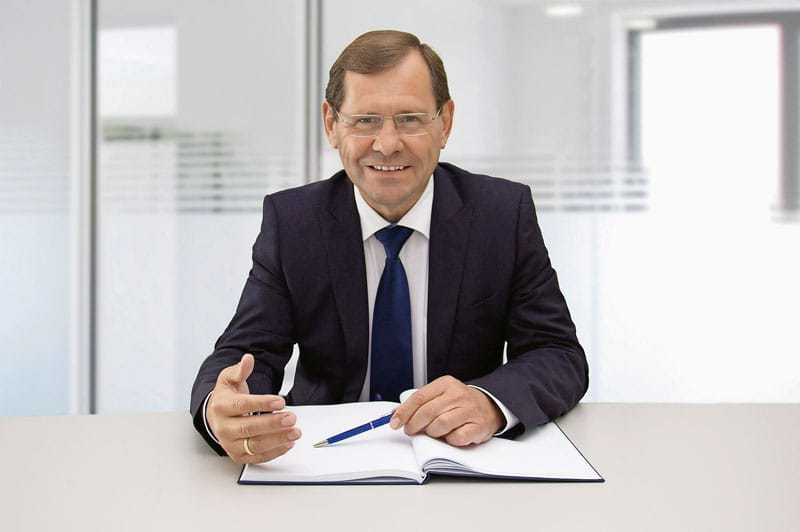
Automotive industry: Mr. Berger, how is this year going for CarGarantie?
Axel Berger: The year is going very well for the industry across Europe. For example, in Germany the principle applies that over three million new registrations are good and under three million are rather bad. If nothing comes up, the current year is expected to bring 3.6 million new registrations. So we're having a good year for cars. Austria is also developing similarly well, the economy is stable, our development in Austria is extremely positive. We grew by around six percent last year. I see this trend again this year and we will probably grow in all markets. I am often surprised myself that we manage to continually generate new business. In many countries we already have contractual relationships with numerous manufacturer organizations, so further growth seems rather difficult. Overall, we are building on our success from last year with around 235 million euros in premium income.
In your opinion, to what extent are retailers exploiting the potential at the point of sale in terms of financing penetration?
In my opinion, due to the more advanced concentration process, the professional appearance in all aspects is also increasing. Overall, however, there is still potential, especially in the area of secondary products such as financing or guarantees. But we have to see it positively. If customer loyalty were already perfect everywhere, we would have nothing left to do.
Why is the potential not being exploited?
I'll now give the example of a service advisor: the customer is often under stress, and the service advisor has a long list of what he should sell to the customer. In terms of type, the service advisor doesn't want that at all. Basically, he doesn't want to sell anything to the customer, he just wants to repair it. The situation is similar with the seller. For example, when the customer is about to buy a car, the salesperson finally gets him ready to sign the purchase contract. And then he should sell him this and that too. Many salespeople then prefer to remain silent and wait for the customer to sign. In general, however, one has to say: professionalization in car dealerships with regard to secondary services has progressed significantly in recent years.
Is the level of suffering sometimes still too low to exploit all of your potential?
I see it the other way around. Suffering is everywhere. Especially when you look at the return on sales. An example from the early days of the guarantee system, which is probably rather questionable today from a labor law perspective: We were unsuccessful in selling additional guarantees to a dealer. However, there was a dealer 30 kilometers away who had almost 80 percent penetration. The managing director then stipulated that every seller who sells a car without an extended warranty must justify this in handwriting on an A4 page. From one day to the next, customers suddenly wanted to take out a guarantee so that he achieved a penetration of 70 percent. It often fails due to human convenience.
How do you see the future of the car dealership? In ten years, will customers still value the test drive, personal advice, the showroom, etc.?
If I were a dealer, I would think very carefully about whether to invest in the showroom, for example. I don't think it makes sense to build a car dealership today that reflects the entire product range in the showroom. I rather assume - especially because of the digital possibilities - that it will look like this from now on: If someone comes to a Mercedes dealer, for example, and wants an E-Class, then an E-Class will be brought here because of the feel. All detailed features such as color, interior design, etc. are projected on corresponding high-resolution screens.
So the car dealership itself has no expiration date?
In principle, the car dealership will continue to be needed in any case. Selling cars exclusively through the manufacturers or over the Internet will not work. Previously, customers visited the car dealership on average between four and five times before purchasing the car. Today the number is between once and twice. That means: you actually only have one chance. On the other hand, this permanent focus on digital should also be viewed with caution. Ultimately, business is still done between people. Of course, the price-performance ratio must be right. Due to price transparency on the intranet, customers are now very well informed, so retailers have to offer fair and competitive prices. However, products are becoming more and more similar, so the main thing is to build good customer relationships. Most people long for it too – especially in the fast digital age.
And in aftersales?
I see the much bigger problems in the workshop area. Car dealerships all over Europe now make their living largely from service. What do I do if claims continue to decline? What if I stop selling motor oil because we only have electric vehicles? I recently read a sentence that I just love: We can't predict the future, but we have to prepare for it. The car trade must be flexible and agile.
How do you see the topic of “individual mobility”?
The topic of “individual mobility” will never be over. This will always take place in some form. However, it is also a fact that the automobile is no longer as much of a status symbol as it once was. Nevertheless, the automobile continues to fascinate and alternative technologies inspire.
What is the future of your business?
There are tendencies that we are expanding our portfolio significantly. This is also because more and more manufacturers are starting to extend factory warranties.
How do you react to that?
We are expanding our own product range. For example tire guarantees, e-bikes, guarantees after service and maintenance, etc. We are also continuing to expand. We will be active in Denmark this year. Also in Thailand, Malaysia and Singapore. Four more countries will be added to the current 19 countries in which we are active. However, a key trend is that we are making our warranty services available to manufacturers and importers as a service provider, thereby further solidifying existing collaborations.
How are you doing specifically in Austria?
We are very satisfied with our status quo in Austria. For us, Austria is the market with the highest penetration rate after Germany. That was around 40,000 guarantees last year. We have a market share of 15 to 20 percent in Austria, and that's decent. We are particularly pleased that we were still able to attract new partners in a market in which we have been represented for a long time, due to our good price-performance ratio and our high level of expertise when it comes to guarantees.
CarGarantie will not have a stand at Automechanika in September or at AutoZum in January. Why not?
We actually have nothing “physical” to present. For us, a trade fair is a contact point, a communication center. We have noticed that our important contacts are coming to trade fairs less and less. At some point we came to the conclusion that we would be better off investing the money in concrete measures and products as well as special promotions for our dealers. But we will be there as usual, albeit without a stand, to meet our partners.