

 Suche
Suche
 Mein Konto
Eurotax boss on the diesel debate
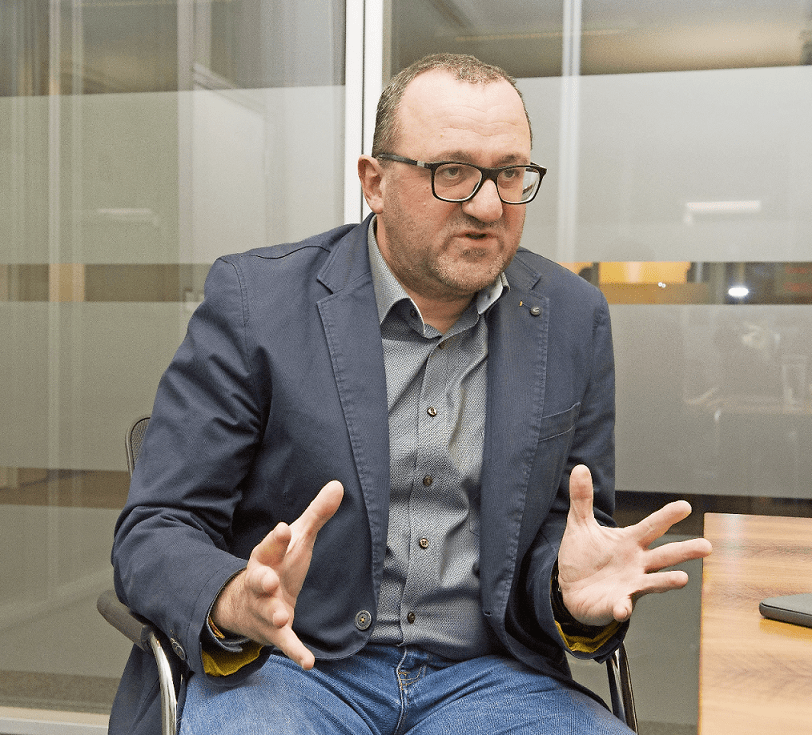
MARTIN NOVAK, Eurotax Group Regional Managing Director Austria, Switzerland and Central & Eastern Europe, in the KFZ Wirtschaft interview.

Eurotax boss on the diesel debate
Automotive industry: What are your assessments for 2018?
Martin Novak:It was an exciting year. In Switzerland, challenges had to be overcome. We have grown from that. We have had a development there that has not been very positive over the last seven to eight years. In my first year as managing director, we have already managed to stabilize things and are generating growth again.
What specific problems have there been in Switzerland?
The problems were diverse. Above all, the sales team no longer fit in with Eurotax. Hard cuts had to be made so that we can now look after our customers in the way I imagine optimal customer care.
How do the markets for which you are responsible differ?
We have grown very federally. The markets are very different, but if we look at what the lowest common denominator is, the challenges are the same. This means that the following are important for all markets: optimal customer service, excellent service quality and a good hotline. And of course data and methods that meet the highest quality standards. With which our customers can generate added value and earn more money. All markets have this in common.
How have the markets developed? And where is Austria?
The individual markets have grown at different rates. Austria is at the forefront when it comes to quality and customer service. In Eastern Europe there are some very young markets such as: B. Romania, where I can still imagine significant changes and improvements.
What is your schedule?
Basically, I give myself two to three years for such measures. A precise plan is worked out. Fortunately, sometimes you see – as in the example of Switzerland – that things can happen more quickly. But there are also good markets in Eastern Europe, such as: B. Poland, which has developed excellently in recent years.
What does your everyday working life look like? Where are you personally present?
In Austria and Switzerland I am present as an active managing director, demonstrate market presence and attend industry events. Apart from that, I am supported by my colleague Piotr Włodarczyk, who is responsible for my Eastern European business.
“Our product portfolio will be completely online and digital”MARTIN NOVAK, EUROTAX
We have often read about “Eurotax’s digitalization strategy” recently. What exactly does this look like?
For us, digitalization means above all: The product portfolio is aligned completely online and digitally. Wherever it was not possible to raise product divisions to a correspondingly high level online, we separated from these divisions. But digitalization also means: communication. Both internally, with great transparency towards all employees, and externally, towards our customers. In general, we communicate via numerous digital channels, but also via social media. From Facebook, LinkedIn and Instagram to Twitter.
How are your appearances on social media received?
It's evolving. We have to make sure that we don't overwhelm our customers. We have to proceed carefully here. The feedback I receive is that the perceived quality and modernity of our multimedia communication is extremely positively received.
Keyword: diesel bashing. Are we already at the zenith of the discussion?
I don't think the discussion will end abruptly. They will probably continue to exist. I find it particularly regrettable that the very modern, clean diesel generations are being tarnished in terms of their image. Although these are demonstrably clean and sensible forms of mobility. Especially for frequent drivers who drive at least 30,000 to 40,000 kilometers per year. A modern technology in which a lot has been invested is being unfairly denigrated here. I understand that outdated technologies are gradually being removed from the market. Basically, this is about predictability. It would be understandable if, for example, it were decided that a certain generation of diesel would no longer be permitted in two or three years or would be taxed higher. But I miss exactly this predictability.
Who is to blame for this? Politics, the media, the automobile manufacturers?
In principle, everyone is to blame. Also the automobile manufacturers, who have also contributed their part to the uncertainty regarding diesel with emissions tricks. And simplistic statements from politicians, especially the Greens. Little by little, the trust of end consumers in diesel has been shaken.
“In principle, WLTP is well-intentioned, but it cannot be surpassed in terms of complexity.”MARTIN NOVAK, EUROTAX
What consequences does diesel bashing have for the used car market?
On average, the downtime days have increased by between eight and ten days; on average we now have a total of 88 downtime days. But that also means that the car has to be financed for more than a week longer before it can be turned.
Is it realistic that the situation will improve significantly again?
I think that will depend on what is decided politically. As long as nothing drastic happens, the door is open to speculation.
Does diesel have a chance of making a comeback?
In my opinion it should be that way. In any case, the Euro 6 generation is one that can be represented for our descendants with a clear conscience.
How did you feel about switching to WLTP?
In principle, WLTP is well-intentioned. But this cannot be surpassed in terms of complexity. As a data provider, we experience first-hand how complicated the implementation is. We ourselves had to increase our team in this area by 30 percent.
What will Eurotax present at AutoZum 2019?
Here too, we will implement the topic of “digitization” visually and in terms of content at our trade fair stand. We still believe completely in direct customer contact. I don't think we can run our business the way Amazon does.
What do you think a car dealership will look like in ten years? Will there still be showrooms, test drives, etc.?
All of this will definitely still exist in five to ten years. However, there will be a concentration. I could imagine that privately run car dealerships are currently being merged into chains in order to be able to better deal with the issue of logistics, for example. But I also completely believe in customer contact in this area. Those companies that are truly top in terms of customer contact and service will continue to be successful. There are so many car dealerships where you feel completely comfortable and receive optimal care. This should never, ever be exchanged for something digital. However, where I am at most just a number or am not noticed at all, it becomes difficult to find an argument for direct customer support. This makes you feel even more at home on the Internet.
So the committed people will still exist?
Yes. If they constantly develop and get better and better.
Are the car dealerships on average good enough today?
I do think that there are a large number of companies in Austria that are excellently managed and offer optimal customer contact.
Final question: 2018 was the third best car year so far in terms of new registrations. What do you expect from 2019?
2018 was - despite the switch to WLTP - an extremely good year for cars. 2019 will also be good, the signs are encouraging.
Are you satisfied with the new government's car and transport policy?
The automotive industry is extremely important for Austria. The current government is obviously predictable when it comes to car policy, and that is good for the industry.